
Exploring
Compare perspectives.
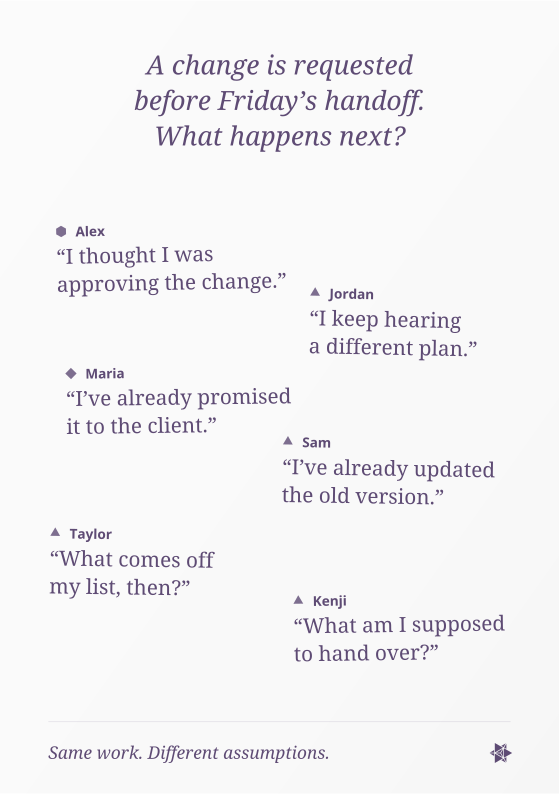
Six people describe the same Friday handoff. Their assumptions differ.
View full page: Exploring
Relational architecture
Relational architecture makes the working arrangements between people visible: responsibilities, decisions, information, commitments, and handoffs. Andrew brings research-informed design guidance; your people help draw, test, and refine arrangements they can use.
The method in practice
We begin with pencil and paper. In the first working session, your people draw how responsibilities, decisions, information, and handoffs connect their work. Andrew draws alongside them, compares perspectives, and helps develop a practical arrangement to try. Other accessible formats are welcome.
The illustrations show Exploring, Drafting, and a wider Blueprinting example. Framing follows adopted agreements into daily use, review, and improvement.
Compare perspectives.
Six people describe the same Friday handoff. Their assumptions differ.
View full page: ExploringVisualize the relationships. Try a clearer way to work.
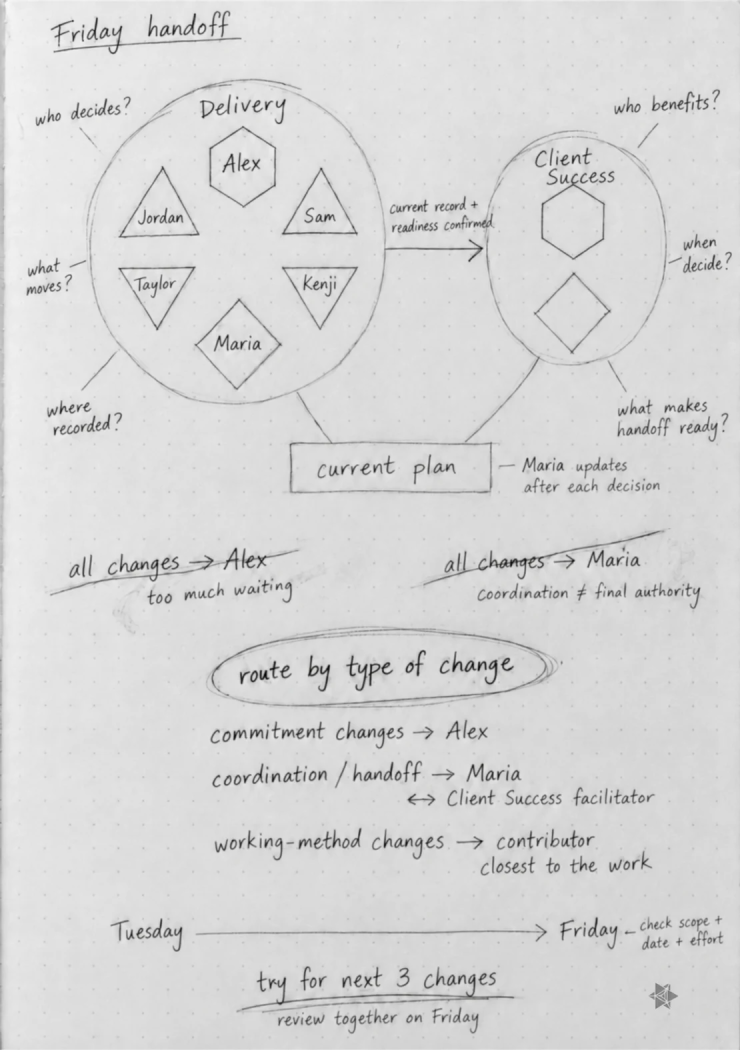
A proposed arrangement is ready for a trial with three changes.
View full page: DraftingMaking working agreements visible.
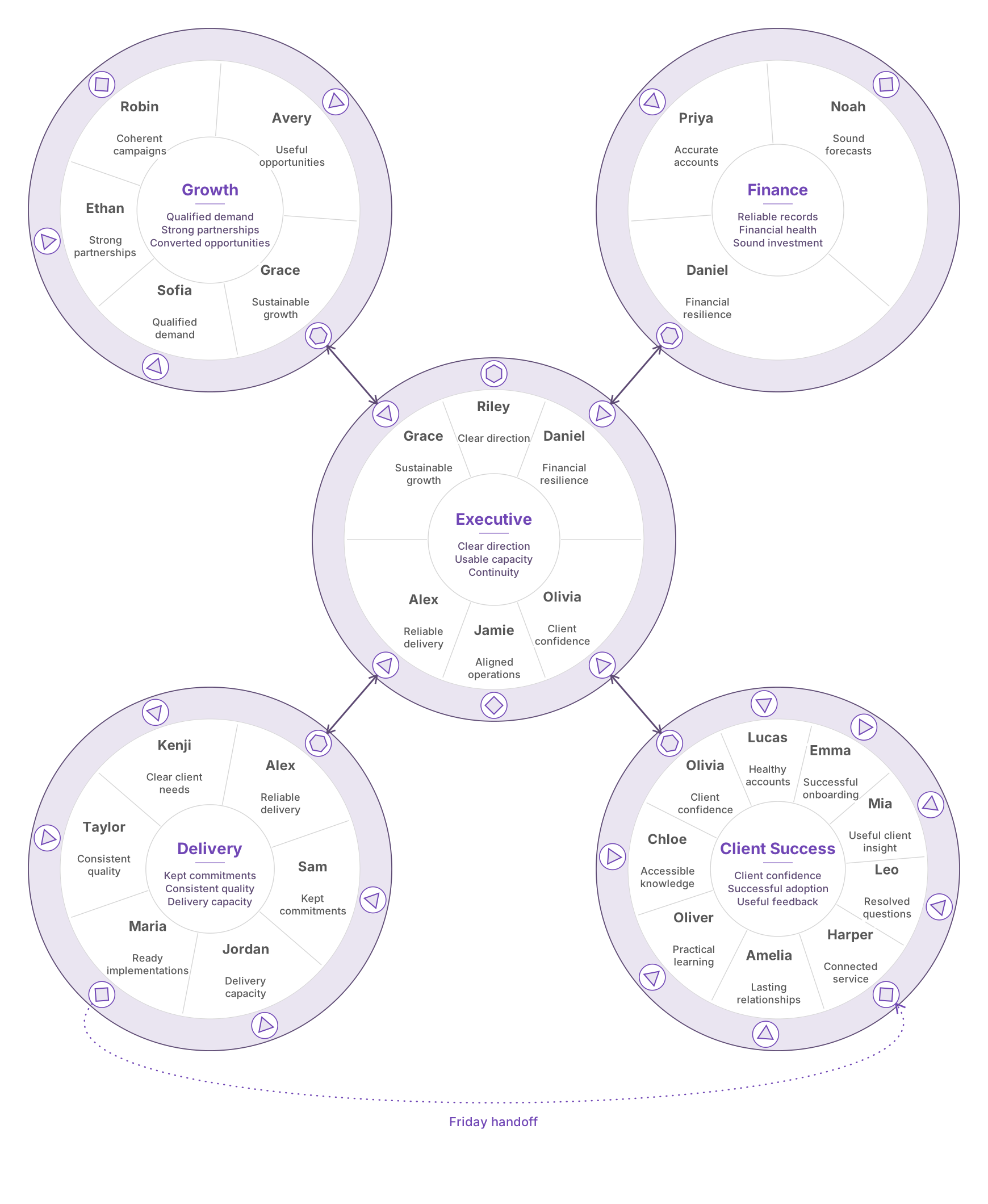
This illustrative organization view shows how shared leadership functions connect teams and how specific agreements clarify coordination.
Maria coordinates Delivery’s adopted Friday handoff to Harper in Client Success. Alex confirms commitment changes within agreed authority.
The first two pages follow one Friday handoff. The five-team page illustrates a wider scope: several connected working arrangements. They are not successive stages of one verified client outcome.
Adapted from anonymized client work. Names, intended contributions and working details are illustrative. Adopted is the illustrated record status.
Inspect the full Blueprinting example Download the printable PDFYour relationprint brings adopted agreements together in a guide you own. Explore the guide
Think together on paper. Keep useful agreements on paper or in digital tools your people choose and maintain.
Adapted from anonymized client work. Names and dialogue are illustrative.
How the work develops
Andrew guides the design and contributes practical recommendations. Your people draw, test, and refine the arrangements they will use; authorized client decision-makers choose what to adopt. Framing keeps those agreements current.
Four C’s. One continuous cycle.
Capacity is the investment and the return. Start at the inner Capacity.
Capacity is both the investment and the possible return. We review what the work required, what people learned, and what changed. A demonstrated gain in usable time, attention, or ability requires evidence; an inconclusive trial can still inform a better decision.

The Prioritizer clarifies direction and commitments within agreed governance; the Facilitator coordinates delivery within delegated authority. Together they compare stakeholder needs with evidence from everyday work and refine decisions through constructive dialogue. These are working functions with clear responsibilities and authority.
Everyone contributes. Prioritizer and facilitator are continuing roles within your team, active across all six dimensions. Andrew facilitates the engagement and helps your people establish their own working agreements.
Processes and operating rhythm connect all six dimensions. A process diagram can sit in an Execution Blueprint, linked to the relevant agreements about ownership, value, coordination, priorities, and information.
Data maintains accurate, current records, measures, feedback, decisions, and captured knowledge, with stewardship, security, and appropriate access. A scorecard is one expression of that work; its measures need a purpose and a decision they inform.
Execution makes agreed methods, standards, and exceptions usable in everyday work. It uses dependable evidence to check results, coordinate handoffs, review the method, and adapt it.
Dimensions of Capacity
Six questions help people examine working arrangements from connected perspectives. Use whichever matter to the situation—whether the work concerns one leader, a team, or an organization.
Ownership
Make ownership, decision authority, and qualified cover clear.
Value
Connect effort to the benefit it creates for the people served.
Cadence
Agree recurring coordination and the events that call for a conversation.
Focus
Choose priorities that fit available capacity and make commitments explicit.
Data
Keep information accurate, current, protected, and easy to find.
Execution
Use agreed methods and dependable evidence to deliver, learn, and adapt.
What you take forward
Your relationprint is a client-owned reference for tested, authorized working agreements. It can start with one Blueprint, kept on paper or in familiar tools, with a current version, maintainer, and review point.
From trial to shared reference
Your proposal names the intended endpoint and the trials, capture, records, and handover included. Focused work can end with a recommendation or trial-ready Draft; adoption follows practical use and review.
See how your guide takes shapeResearch & established practice
These are the key influences selected for their relevance to this approach. Each contributes a useful idea; the application is shaped around your people and work.
The questions connect ownership, purpose, coordination, priorities, information, and working methods. The overlap is the point: an answer in one area can change the others.
Use whichever question helps with the situation. The sources below inform the practice; trials establish what helps in your work.
Research
Jody Hoffer Gittell
Strengthen the relationships that connect the work.
Explore shared goals, shared knowledge, mutual respect, and timely communication. Agree how people coordinate across roles and teams.
Ownership · Cadence · Execution
The cited study examined care-provider groups. Its findings inform questions we test in each client’s setting.
[1] Gittell, J. H. (2002). Coordinating Mechanisms in Care Provider Groups: Relational Coordination as a Mediator and Input Uncertainty as a Moderator of Performance Effects. Management Science, 48(11), 1408–1426. DOI: 10.1287/mnsc.48.11.1408.268.
Research
Amy Edmondson
Make room for candor and learning.
Invite people to compare expectations, question assumptions, and discuss the working arrangement together. Leaders model curiosity and respond constructively.
Ownership · Value
The study linked team psychological safety with learning behavior. Safety depends on everyday conduct, authority, and follow-through.
[2] Edmondson, A. (1999). Psychological Safety and Learning Behavior in Work Teams. Administrative Science Quarterly, 44(2), 350–383. DOI: 10.2307/2666999.
Research & theory
Richard Ryan & Edward Deci
Support autonomy, capability, and connection.
Pair accountability with appropriate authority. Give people the support and capacity to carry their responsibilities, contribute expertise, and participate in agreements.
Ownership · Value
Autonomy, competence, and relatedness inform the conditions for motivation. The practical arrangements are shaped with the people involved.
[6] Ryan, R. M., & Deci, E. L. (2000). Self-Determination Theory and the Facilitation of Intrinsic Motivation, Social Development, and Well-Being. American Psychologist, 55(1), 68–78. DOI: 10.1037/0003-066X.55.1.68.
Management theory
R. Edward Freeman
Let the people who benefit help define value.
Gather feedback from customers and other stakeholders. Use their needs to clarify worthwhile outcomes and inform the prioritizer’s tradeoffs.
Value · Focus
Stakeholders include people who contribute to, benefit from, or are affected by the work. Their needs can differ and require explicit choices.
[9] Freeman, R. E. (1984). Strategic Management: A Stakeholder Approach. Pitman. See also the University of Virginia Darden School of Business, Olsson Center, stakeholder-theory research overview.
Design framework
Jay Galbraith
Align the whole arrangement around the work.
Consider how strategy, structure, processes, rewards, and people interact. Examine a local agreement in the context of the wider organization.
All six dimensions
This informs a whole-system perspective. The six relationprint dimensions are a separate synthesis with their own questions and language.
[8] Galbraith, J. R. The Star Model™. Galbraith Management Consultants. Official framework summary; reviewed 5 October 2026.
Improvement framework
Associates in Process Improvement · IHI
Try a change. Learn from use.
Set an aim, choose useful evidence, and run a bounded trial. Review what happened before adapting or adopting the agreement.
Cadence · Focus · Execution
Plan–Do–Study–Act cycles inform practical testing. Clients choose measures that reflect their work, including time invested, learning, and any evidenced return in usable time, attention, and ability.
[3] Institute for Healthcare Improvement. Model for Improvement, including Plan–Do–Study–Act cycles. Guidance accessed 4 October 2026.
Problem-solving practice
Toyota tradition · Lean Enterprise Institute
Give different perspectives a shared page.
Capture the situation, evidence, proposed change, and follow-through concisely. Use the draft to support dialogue and a clear next experiment.
Focus · Data · Execution
The inquiry and conversation are central. The page format supports the thinking and stays proportionate to the situation.
[4] Lean Enterprise Institute. A3 Report. Lean Lexicon. Guidance accessed 4 October 2026.
Practice principles
Authors of the Agile Manifesto
Learn in short cycles at a sustainable pace.
Make useful progress visible, review it regularly, and adapt as needs change. Agree a coordination rhythm that supports the people doing the work.
Cadence · Focus · Execution
These principles originated in software development. We adapt feedback, sustainable pace, and reflection to the client’s operational setting.
[10] Beck, K., et al. (2001). Manifesto for Agile Software Development: Principles behind the Agile Manifesto. Official principles; reviewed 5 October 2026.
Research
Suwa & Tversky · Wammes, Meade & Fernandes
Make relationships easier to examine and remember.
Use words and simple diagrams to externalize ideas, compare perspectives, and revisit assumptions. Begin on paper, with accessible alternatives throughout.
All six dimensions
These studies concern architectural reasoning and controlled memory tasks. Shared organizational understanding is established through discussion and practical use.
[5] Suwa, M., & Tversky, B. (1996). What Architects See in Their Sketches: Implications for Design Tools. CHI ’96 Conference Companion.
[7] Wammes, J. D., Meade, M. E., & Fernandes, M. A. (2016). The drawing effect: Evidence for reliable and robust memory benefits in free recall. Quarterly Journal of Experimental Psychology, 69(9), 1752–1776. DOI: 10.1080/17470218.2015.1094494.
Knowledge theory
Ikujiro Nonaka
Connect lived experience with useful shared records.
Bring practical know-how into conversation and drafts. Capture adopted agreements with a maintainer, accessible location, and review point.
Data · Execution
Nonaka’s theory connects tacit and explicit knowledge. Records complement experience, practice, and relationships.
[11] Nonaka, I. (1994). A Dynamic Theory of Organizational Knowledge Creation. Organization Science, 5(1), 14–37. DOI: 10.1287/orsc.5.1.14.
Visualization framework
Simon Brown
Show the right detail at the right scale.
Keep organization, team, and profile views connected through stable identifiers. Let each view answer a clear question for its audience.
Ownership · Data
C4 describes software architecture. Relationprint adapts the principle of connected levels of detail into its own human-system diagrams.
[12] Brown, S. The C4 Model for Visualising Software Architecture. Official model: hierarchical abstractions, diagrams, and notation. Reviewed 5 October 2026.
Operational guidance
FEMA
Keep essential work covered as circumstances change.
Identify essential work and qualified cover. Confirm authority, access, handover, and activation conditions. Rehearse critical arrangements and review readiness.
Ownership · Data · Execution
FEMA provides continuity guidance. Its principles are adapted proportionately; relevant legal, safety, and regulatory requirements receive specialist review.
[13] Federal Emergency Management Agency (2018; updated 2024). Continuity Guidance Circular. Essential functions, succession, delegated authority, essential records, and exercises.
Start with a conversation
Explore a useful starting point for your leadership, team, or organization.
Prefer to reflect first? The Capacity Snapshot offers 20 questions and an immediate personal summary.